Before you spend a dollar on treatment, know exactly what's in your water. Our free, no-pressure in-home test takes about 30 minutes and gives you a clear picture of your Castle Rock water — and whether you even need anything.
Treatment recommendations should be based on site conditions and measured water quality.
Know your water before you treat it
Guessing leads to overspending — either on a system you don't need or one that's the wrong fit. A proper test removes the guesswork. We come to your home, sample your water where it matters, and walk you through the results in plain English while we're there.
What we test for
Hardness — the grains-per-gallon behind scale and spots
Iron & manganese — the cause of orange and black staining
Chlorine / chloramine — taste and odor on city water
Total dissolved solids (TDS) — overall mineral load
pH — acidity that can corrode pipes and fixtures
Sulfur & odors — the "rotten egg" smell, common on wells
What to expect
About 30 minutes, at a time that works for you
On-the-spot results you can actually see and understand
Straightforward guidance — including "you're fine, do nothing"
No high-pressure sales and zero obligation to buy
If you do want a solution, an upfront price and financing options
City water or private well, we test both. On a well, see our well water treatment page for the full picture — and try the hard water cost calculator to estimate what hardness may be costing you now.
What we actually test in your Castle Rock home
Our free in-home water test measures total hardness (grains per gallon), pH, chlorine/chloramine presence for city-supplied homes, and — for private wells — a broader screen covering iron, sulfur, and sediment. We do this on-site with your actual tap water, not a generic zip-code estimate, because hardness and mineral content genuinely vary block to block across Castle Rock's blended municipal supply and neighborhood-specific well sources.
Why test before buying equipment
Sizing a softener, filter, or RO system without a real test is the single most common reason equipment underperforms or fails early — a system sized for "average" 15 gpg water will regenerate constantly and wear out fast on a well running 28 gpg, and the reverse wastes salt and water on a lighter supply. Your free test gives us the exact numbers so any recommendation that follows is built for your home, not a guess.
What happens during the visit
A technician visits at a time that works for you, draws water samples from your kitchen tap (and outdoor spigot for well homes), runs the on-site test kit, and walks you through the results in plain language — no jargon, no pressure to buy. If treatment makes sense, you'll get an upfront, itemized quote on the spot; if it doesn't, we'll tell you that too.
No obligation, ever
The test itself is completely free and comes with zero commitment. Many Castle Rock homeowners use it simply to confirm what they suspect (hard water, iron staining, chlorine smell) before deciding whether to move forward — there's no cost either way.
Water testing FAQ
How long does the test take? Most in-home visits take 20-30 minutes including the walkthrough of results.
Do I need to prepare anything? No — just have access to your kitchen tap (and outdoor spigot if you're on a well) when we arrive.
Is this the same as a lab test? Our on-site test covers the most common and actionable parameters (hardness, pH, chlorine, iron/sulfur screening); for bacteria or nitrate certification (recommended annually for wells), we can point you to a certified lab.
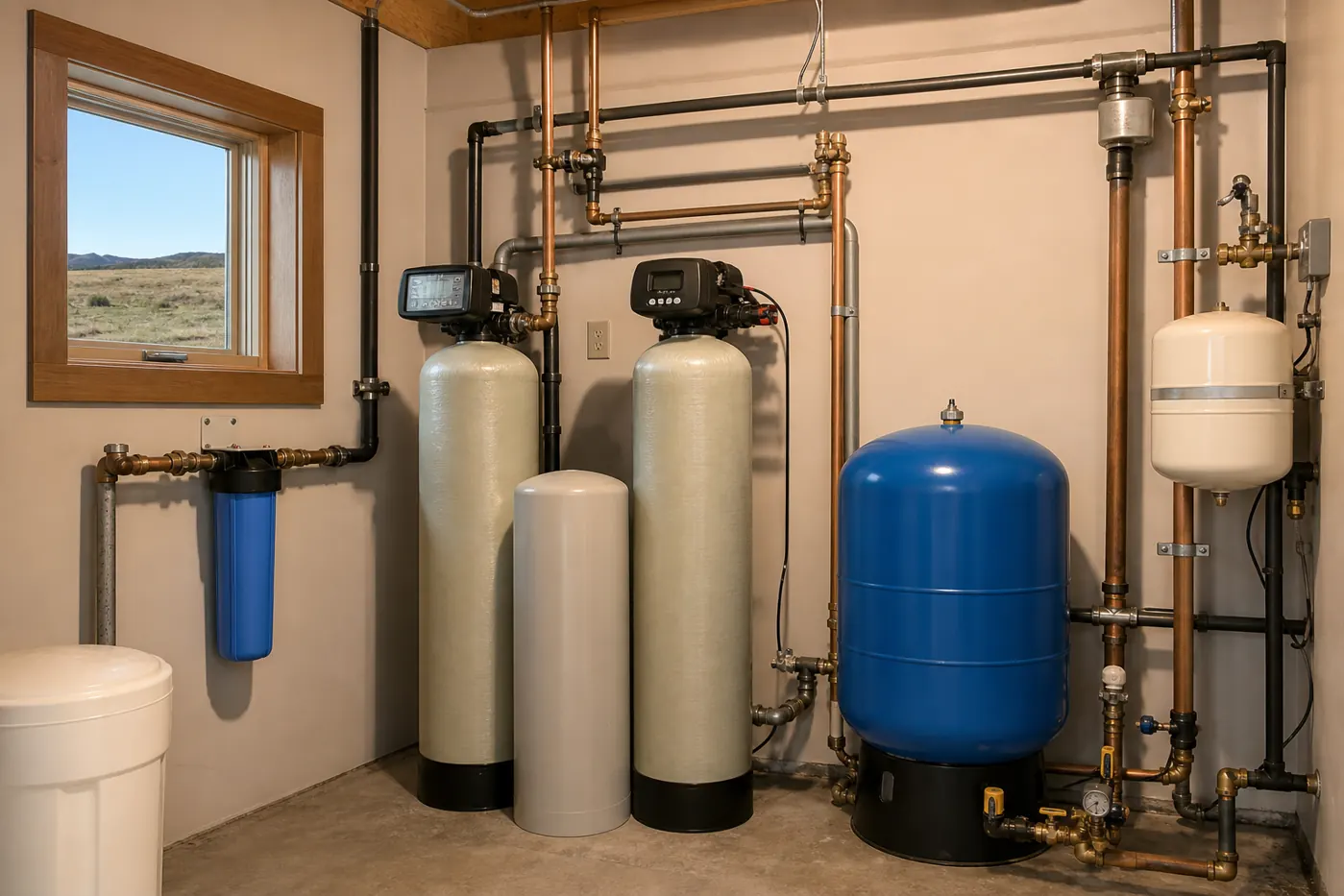
Illustrative equipment and testing imagery; final systems depend on the property and water analysis.
What a Castle Rock Water Test Can—and Cannot—Tell You
An in-home screening can quickly measure hardness, pH, chlorine residual, total dissolved solids, and sometimes iron or other aesthetic indicators. Those results are useful for sizing equipment and understanding scale, taste, odor, or staining. They are not a substitute for certified laboratory analysis when the question involves bacteria, nitrate, arsenic, lead, or another health-related contaminant.
Preparing for an accurate sample
Tell the tester whether the tap is supplied by municipal water or a private well and identify any equipment already in service. Samples should be taken both before and after existing treatment when possible. Remove faucet aerators only when the sampling protocol calls for it, and avoid collecting immediately after plumbing work unless the goal is to investigate that work.
Reading the recommendation
A useful report links each proposed treatment stage to a measured result or clearly stated concern. Hardness supports softener sizing; chlorine or odor may support activated carbon; sediment calls for a particle-control strategy. Total dissolved solids alone does not identify which substances are present, and a sales demonstration should never be mistaken for a complete safety assessment.
Municipal water reports and private-well laboratories
Municipal customers can review the local annual water-quality report for system-wide regulated testing, then use an in-home test to understand conditions at their own tap. Private-well owners should use a Colorado-certified laboratory for health parameters. The laboratory can supply containers, preservation instructions, holding times, and a chain-of-custody process where needed.
Homes built before modern lead-free plumbing standards, properties with unusual plumbing materials, and households with infants or immunocompromised residents may merit more targeted testing. Treatment selection should follow the result rather than guesswork.
After testing: verify the fix
Record baseline values, the sample location, date, and whether treatment was bypassed. After installation, repeat relevant measurements under normal operating conditions. Verification is especially important for contaminant-specific systems and private wells. Maintenance reminders, replacement dates, and periodic retesting turn a one-time equipment purchase into a reliable water-quality plan.
Castle Rock Water Quality: Current Local Context
Castle Rock’s official 2026 water-quality report lists 2025 hardness averaging 100 parts per million as calcium carbonate, with results ranging from 61 to 182 ppm—about 3.6 to 10.6 grains per gallon. The Town describes the supply as moderately hard. The report also explains that roughly 70% of 2025 supply came from 63 deep Denver Basin wells and 30% from renewable sources. Because blend and household conditions vary, test the tap before selecting equipment.
Municipal water is treated to meet drinking-water requirements; additional in-home equipment is a personal choice for goals such as reducing scale, changing taste, or adding point-of-use treatment. Private wells are different: Douglas County says owners are responsible for water quality and recommends testing drinking-water wells seasonally or after maintenance. Health-related contaminants require appropriate certified-laboratory testing.