Castle Rock’s official 2025 results ranged from roughly 3.6 to 10.6 grains per gallon in the Town’s 2025 test range. A properly sized whole-home softener ends the scale, spots, and dry skin for good.
Treatment recommendations should be based on site conditions and measured water quality.
Why Castle Rock homes need a softener
"Hard" water simply means water carrying dissolved calcium and magnesium. Douglas County's deep-well and blended supplies are especially high in both. Every time that water is heated or evaporates, those minerals precipitate out as scale — the chalky crust on your faucets, the cloudy film on your glasses, and the hidden buildup coating the inside of your water heater and pipes.
A water softener solves this at the source using a process called ion exchange: hard water passes through a tank of resin beads that swap the hardness minerals for a tiny amount of sodium (or potassium). What comes out the other side is soft water that rinses clean, lathers easily, and stops destroying your appliances.
Signs your Castle Rock home has a hard-water problem
White, crusty scale on faucets, showerheads, and glass shower doors
Spotty, cloudy dishes even straight out of the dishwasher
Dry, itchy skin and dull, hard-to-manage hair
Stiff, scratchy laundry that fades quickly
Rising energy bills and water heaters that fail early
Soap and shampoo that never seem to lather or rinse fully
What a softener changes in your home
In your home
Hard water
Softened water
Dishes & glassware
Spotty & cloudy
Spotless
Skin & hair
Dry & dull
Soft & smooth
Appliance lifespan
Shortened by scale
Up to 30% longer
Soap & detergent use
High
Cut by up to half
Water heater efficiency
Drops as scale builds
Stays efficient
What's included with your install
Free in-home water test and correct sizing for your household
Professional, single-day installation by independent local professionals
High-efficiency, metered softener that regenerates only when needed
Walkthrough of your new system plus salt-delivery and service options
Upfront pricing and financing — with clear written terms
Sizing a softener correctly for Castle Rock's water
Every Castle Rock home is different — a 1,800 sq ft home in The Meadows with two people uses far less capacity than a five-bedroom house in Founders Village on a private well. We size every system to three numbers: your actual water hardness (measured on-site, not assumed), your household's daily gallons used, and your peak-flow fixture count. Undersized softeners regenerate constantly and burn through salt; oversized units waste water on regeneration cycles you don't need. Getting this right the first time is the single biggest factor in whether a softener actually pays for itself.
Salt-based vs. salt-free: what Douglas County homes actually need
Salt-based ion-exchange softeners are still the only technology proven to remove hardness minerals from water — salt-free "conditioners" only alter how the minerals behave (reducing scale adhesion) without actually softening the water. For Castle Rock's the measured hardness at your tap water, true ion exchange is almost always the right call; salt-free systems are typically reserved for households on a sodium-restricted diet or municipalities that restrict softener discharge, which is not currently a factor here.
What installation day looks like
Our independent service professionals arrive with the sized unit already configured from your free water test. Most single-day installs involve tying into the main line after the pressure tank or meter, setting the bypass valve, running the drain line to a nearby floor drain or standpipe, and programming the control head to your household's actual usage pattern — not a generic factory default. You'll get a full walkthrough of the bypass valve (for troubleshooting), the salt tank fill level, and your first-year maintenance schedule before we leave.
Maintenance & salt delivery for Castle Rock homeowners
A modern metered softener needs very little upkeep: checking the salt level roughly monthly, keeping the resin bed clean with an annual resin-cleaner treatment, and an occasional professional inspection every 3-5 years. We offer optional salt delivery and maintenance plans so Castle Rock homeowners never have to think about it — we track your usage and show up before you run low.
Frequently asked softener questions
Will a softener remove iron from my water? Standard softeners handle low levels of ferrous iron along with hardness, but higher iron levels (common in some Franktown and Sedalia wells) may need a dedicated iron filter ahead of the softener — we'll flag this during your free test.
Is softened water safe to drink? Yes — the sodium added through ion exchange is minimal (comparable to a slice of bread per glass for most hardness levels). Many households pair a softener with a reverse-osmosis tap for drinking water anyway, for taste and extra polish.
How long does a softener last? A quality valve and resin bed properly sized and maintained typically lasts 10-15 years in Castle Rock's water conditions.
Can I install a softener myself? You can, but incorrect sizing and drain-line installation are the two most common DIY mistakes we get called to fix — professional installation with a proper free water test avoids both.
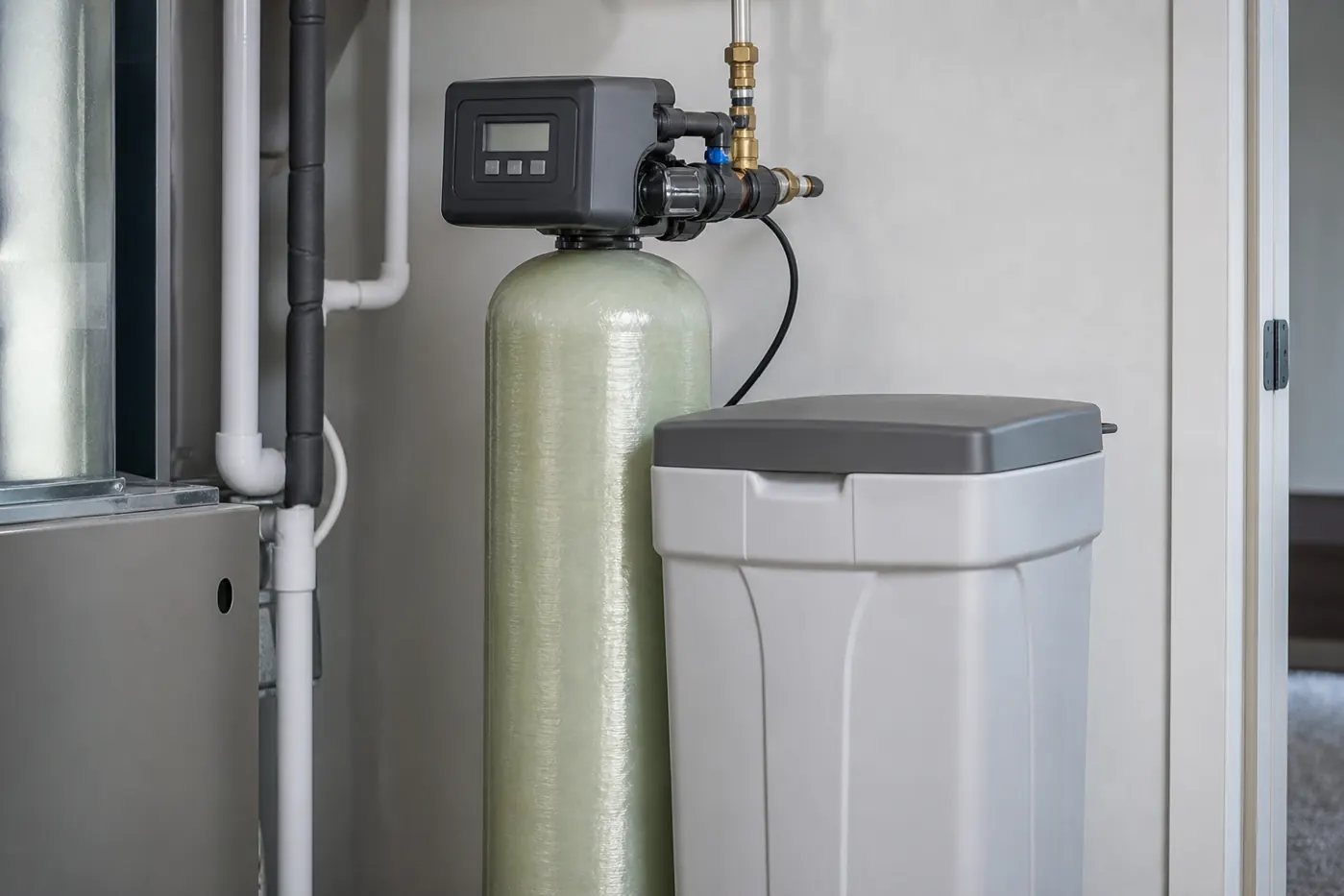
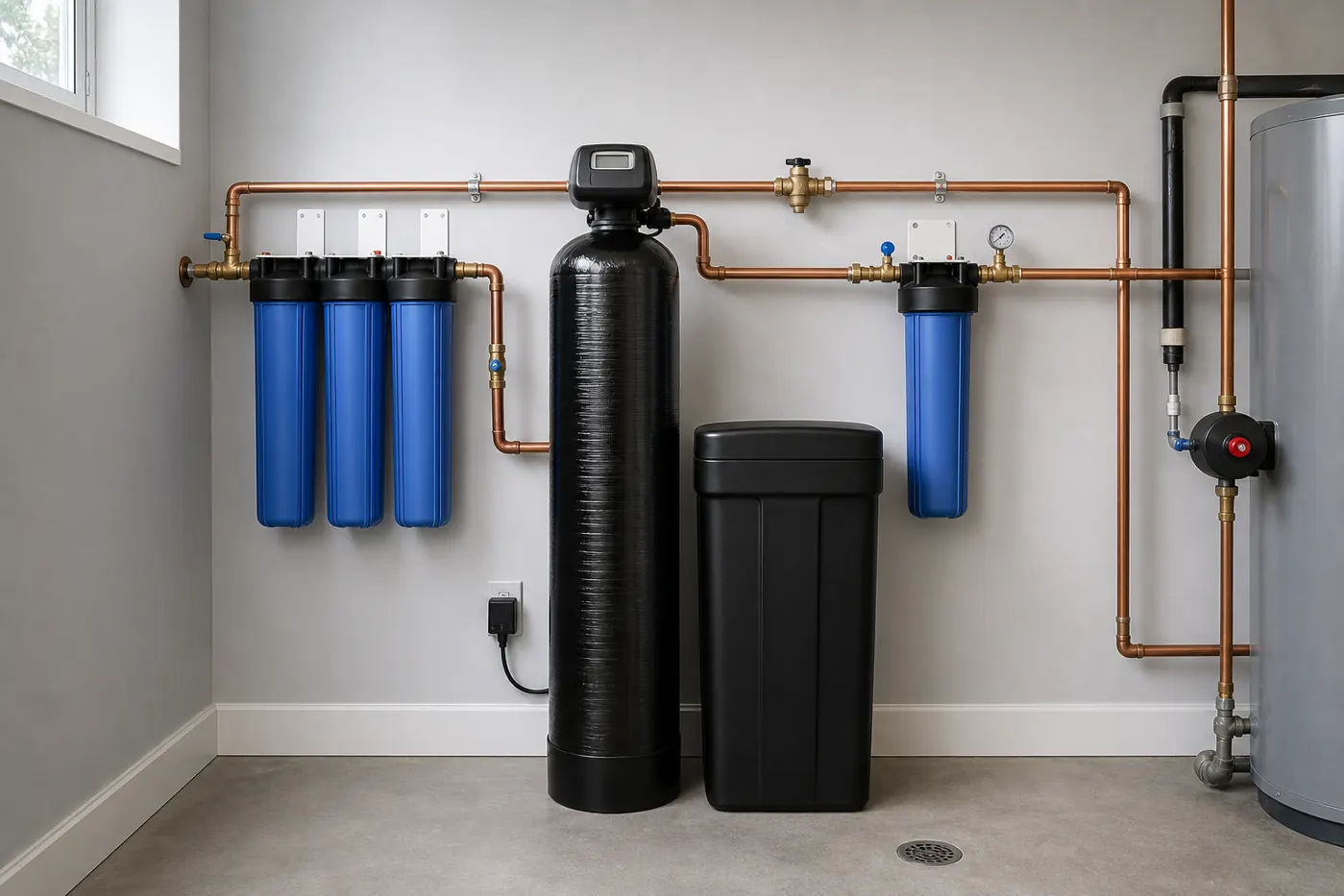
Illustrative equipment and testing imagery; final systems depend on the property and water analysis.
Water Softener Performance in Castle Rock’s Climate
Castle Rock’s elevation, dry air, and mineral-heavy source water create a combination homeowners notice quickly. Water droplets evaporate faster from shower glass, fixtures, and dark countertops, leaving concentrated calcium and magnesium behind. A correctly programmed ion-exchange softener prevents those deposits instead of asking you to dissolve them repeatedly with acidic cleaners.
Capacity, flow rate, and regeneration
Capacity is not just a tank-size question. The right design balances measured hardness, average daily use, peak flow, and reserve capacity. A family using several showers while a dishwasher runs needs enough service flow to avoid hardness breakthrough. Metered regeneration responds to actual gallons used; it is generally more efficient than a timer that regenerates whether the resin is exhausted or not.
Plumbing layout and bypass access
The preferred location is close to the home’s main water entry, an approved drain, a grounded electrical outlet, and enough clear space for service. Exterior irrigation should normally bypass the softener so treated water is reserved for indoor fixtures. A three-valve or integrated bypass allows water to remain available if the system ever needs maintenance.
Water softener costs and ownership considerations
Installed cost depends on hardness, household demand, plumbing access, equipment quality, and whether pretreatment is needed. A test-first recommendation is more useful than a one-size online price because iron, sediment, or chlorine can change the treatment train. Ask any provider to identify equipment capacity, valve warranty, labor warranty, expected salt use, drain requirements, and what ongoing service is optional versus required.
Salt consumption varies with water use and efficiency settings. Keeping the brine tank roughly one-third to two-thirds full, breaking up salt bridges, and using clean pellet or solar salt helps maintain reliable operation. Potassium chloride may be an alternative for some households, though it generally costs more and may require programming adjustments.
Choosing a Castle Rock water-treatment provider
Compare recommendations based on the measured problem, not on brand claims alone. A useful proposal should show the hardness result, estimated peak flow, equipment specifications, installation location, drain plan, total installed price, warranty, and maintenance expectations. For homes with private wells, request broader laboratory testing whenever health-related contaminants are a concern; a basic hardness strip does not establish microbiological safety.
Castle Rock Water Quality: Current Local Context
Castle Rock’s official 2026 water-quality report lists 2025 hardness averaging 100 parts per million as calcium carbonate, with results ranging from 61 to 182 ppm—about 3.6 to 10.6 grains per gallon. The Town describes the supply as moderately hard. The report also explains that roughly 70% of 2025 supply came from 63 deep Denver Basin wells and 30% from renewable sources. Because blend and household conditions vary, test the tap before selecting equipment.
Municipal water is treated to meet drinking-water requirements; additional in-home equipment is a personal choice for goals such as reducing scale, changing taste, or adding point-of-use treatment. Private wells are different: Douglas County says owners are responsible for water quality and recommends testing drinking-water wells seasonally or after maintenance. Health-related contaminants require appropriate certified-laboratory testing.